Porque é que o seu melhor trabalho de IA pertence a um marketplace
A primeira ferramenta de IA que uma empresa constrói é entusiasmante. A quinta é onde começam os problemas.
A essa altura, três equipas escreveram cada uma a sua versão de "resume isto no nosso tom de voz". Duas fixaram no código uma cor de marca ligeiramente diferente. Uma colou uma chave de API num script onde não devia estar. Ninguém sabe dizer qual é o prompt bom, e alguém que entrou de novo reconstrói metade do zero porque não sabia que já existia.
O problema mudou de forma, em silêncio. Já não é como construir capacidades de IA, essa parte ficou fácil. É como reutilizá-las sem perder o controlo da qualidade, da segurança e da marca. É esse o problema que um marketplace interno resolve, e é a diferença entre uma empresa que faz IA como uma sequência de experiências avulsas e uma que a opera como infraestrutura.
Este é o argumento para construir um: o que é de facto, os três problemas que resolve, o que entra nele, como o organizar em camadas, e como o curar para que não apodreça.
O que é de facto um marketplace
Tirando a palavra, um marketplace é um catálogo curado de capacidades de IA reutilizáveis e validadas, que qualquer pessoa na empresa pode encontrar e instalar em vez de reconstruir. Um sítio, uma versão por capacidade, um dono com nome para cada uma. As capacidades são coisas como um padrão de voz de escrita, um conjunto de regras de segurança, um gerador de documentos, um fluxo de conteúdo, um pequeno agente para uma tarefa específica.
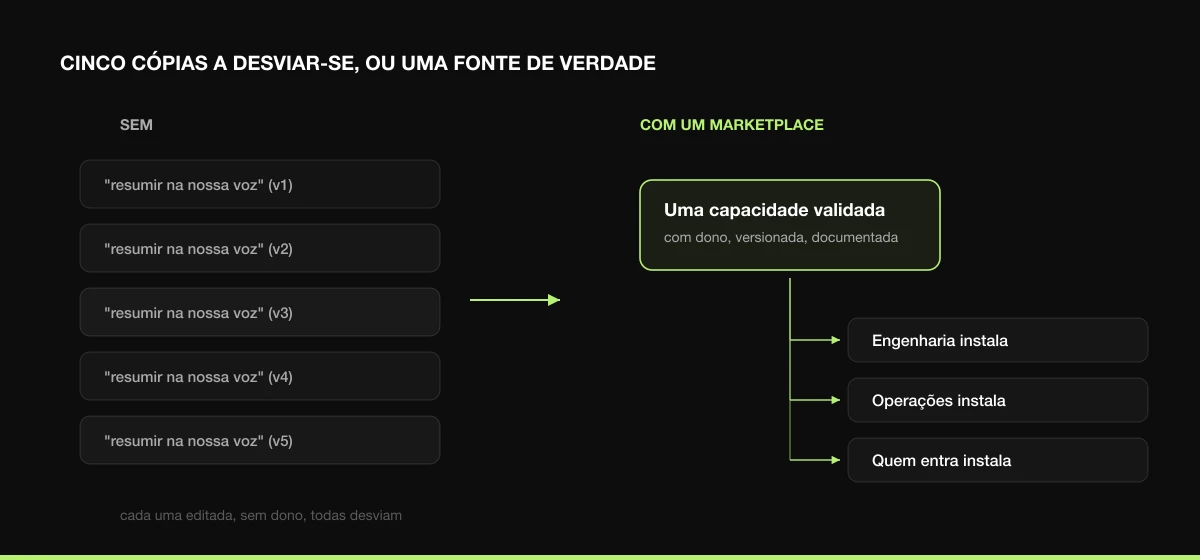
É a mesma ideia que as bibliotecas de componentes trouxeram à engenharia e que as equipas de tooling interno trouxeram aos dados: parar de resolver o mesmo problema cinco vezes, de cinco formas ligeiramente diferentes e ligeiramente erradas. O valor não é o catálogo em si. É que o catálogo se torna a única fonte de verdade, para que uma melhoria feita uma vez chegue a todos, e uma regra definida uma vez seja seguida em todo o lado.
Os três problemas que resolve
Duplicação e desvio
Quando uma capacidade vive num só sítio, uma correção ou melhoria propaga-se a todas as equipas que a usam. Quando é copiada para cinco ferramentas, cada cópia desvia-se. Seis meses depois, a empresa tem cinco respostas diferentes para "como escrevemos um email de seguimento", nenhuma com dono, todas subtilmente desatualizadas. Um marketplace torna "construir uma vez, usar em todo o lado" o padrão em vez da exceção, e transforma uma melhoria em algo que se acumula em vez de algo que tem de ser reaplicado à mão em cinco sítios.
O custo do desvio raramente é uma falha dramática. É um imposto lento: resultados ligeiramente desalinhados, tempo gasto a reconciliar versões, e a erosão silenciosa de uma voz e de um padrão consistentes.
Governação, aplicada uma vez
Esta é a parte que mais importa às operações, à segurança e ao jurídico. Regras, nunca colar dados de clientes num prompt, usar exatamente estes tokens de marca, tratar dados pessoais desta forma, escrever assim, podem viver como fundações partilhadas sobre as quais todas as outras capacidades são construídas. Defina a barreira uma vez; tudo no catálogo a herda.
A alternativa é esperar que cada equipa se lembre de cada regra de cada vez. Isso não escala, e não sobrevive a uma auditoria. Um marketplace transforma a governação de um memorando que as pessoas deviam ter lido numa propriedade das próprias ferramentas. Quando uma regra muda, muda-a num só sítio e todas as capacidades que a referenciam ficam atualizadas, não trinta cópias espalhadas que tem primeiro de encontrar.
Integração de novas pessoas e memória institucional
Quem entra de novo deve instalar o que existe, não reconstruí-lo. Sem um catálogo, cada nova pessoa redescobre os mesmos prompts, repete os mesmos erros, e reaprende as mesmas lições que partiram com quem as escreveu. Um marketplace transforma o conhecimento institucional em algo que se entrega a alguém no primeiro dia. A pergunta escassa passa de "quem aqui sabe o prompt bom" para "o que está no catálogo", e essa pergunta tem uma resposta que sobrevive à saída das pessoas.
O que entra nele
Um catálogo útil contém alguns tipos distintos de capacidade, cada um com um dono e uma descrição clara de quando recorrer a ele:
- Padrões, a voz de escrita, os tokens de marca, as regras de segurança e privacidade. São as fundações contra as quais tudo o resto é avaliado.
- Geradores, produtores de documentos e materiais: apresentações de marca, propostas, one-pagers, pacotes de conteúdo.
- Fluxos de trabalho, processos de vários passos: uma cadeia de conteúdo do tema ao post, um fluxo de recrutamento, um construtor de campanhas.
- Agentes e ferramentas, pequenos auxiliares para uma tarefa específica, que fazem uma coisa de forma fiável.
A propriedade que os une é que cada entrada é uma unidade empacotada e reutilizável, com um nome, uma descrição que diz quando a usar, um dono e uma versão, não um prompt engenhoso enterrado no histórico de conversa de alguém.
Organize em camadas: fundações, depois domínios
Um marketplace funciona melhor em camadas, e a estratificação é o que impede a governação de se tornar um exercício de copiar-e-colar.
Na base ficam os não-negociáveis partilhados: como escrevem, o que nunca expõem, a identidade visual, as regras de tratamento de dados e de licenciamento. Por cima ficam os catálogos de domínio, um para práticas de engenharia, um para operações de negócio e marketing, e assim por diante. Cada capacidade de domínio referencia as fundações em vez de as repetir. Por isso, quando uma regra muda, muda uma vez na base e propaga-se para cima; nada a jusante guarda a sua própria cópia desatualizada.
É exatamente assim que o estruturamos, para nós e para clientes: uma camada de fundações que é dona das barreiras (voz, segurança, marca, privacidade, jurídico, acessibilidade), e marketplaces de domínio separados, engenharia, operações, construídos por cima dela. A disciplina que faz isto manter-se é uma regra: as capacidades vivem num só sítio e são referenciadas, nunca duplicadas. A duplicação é como o desvio volta a instalar-se, por isso a arquitetura é desenhada para tornar referenciar mais fácil do que copiar.
Cure-o, ou apodrece
Um marketplace vale o que vale a sua curadoria. Um catálogo onde qualquer pessoa pode acrescentar o que quiser, sem revisão e sem dono, torna-se um depósito de tralha, e um depósito é pior do que nada, porque parece ordem enquanto espalha o mesmo desvio que se queria travar. Uma pessoa nova que instala três coisas que não funcionam confia menos no catálogo do que se ele estivesse vazio.
A curadoria é o verdadeiro trabalho, e é leve mas inegociável:
- Cada entrada tem um dono. Um nome, não uma equipa. O dono mantém-na atual e responde por ela.
- Cada entrada justifica o seu lugar. Uma descrição clara do que faz e de quando a usar. Se não consegue escrever isso em duas linhas, não está pronta.
- As entradas são retiradas. O que deixa de ser usado, ou é substituído por uma capacidade mais recente, é removido, não deixado a confundir a próxima pessoa.
- Há uma porta de entrada. Uma revisão leve antes de algo entrar no catálogo: segue as fundações, duplica algo que já existe, está documentado. Leve, mas a sério.

É esta a diferença entre um marketplace e uma pasta. Uma pasta acumula. Um marketplace é tratado.
Quando precisa de um, e quando não
A maioria das empresas não está na fase do marketplace, e forçá-lo cedo é por si só um desperdício. Se tem duas ferramentas de IA, tem uma pasta, não uma plataforma, e o custo de um catálogo excede o seu valor. Construa primeiro as ferramentas.
Os sinais de que está pronto são específicos:
- A mesma capacidade está a ser reconstruída por pessoas diferentes que não sabiam que ela existia.
- Uma regra que lhe importa, tratamento de dados, marca, voz, está a ser seguida de forma inconsistente, ou esquecida.
- As pessoas novas começam do zero e reaprendem as mesmas lições.
- Já não consegue responder a "que capacidades de IA temos, e qual é a versão atual de cada uma".
Quando dois ou mais destes pontos são verdade, o estrangulamento passou da construção para a reutilização e a governação, e mais uma ferramenta não o resolve. O que o resolve é um sítio onde pôr as boas, com as regras embutidas no chão.
A mudança que isto cria é mais do que arrumação. Quando o catálogo é bom, a esperteza individual conta menos e a capacidade partilhada e validada conta mais, que é exatamente o ponto em que a IA deixa de ser uma coleção de experiências e passa a ser infraestrutura sobre a qual a empresa inteira se acumula. É essa a diferença entre fazer IA e operá-la.


 Miguel Vicente Jr
